Top Ultrasonic Spot Welder Benefits for Global Buyers?
In recent years, the adoption of Ultrasonic Spot Welders has surged across various industries. This technology offers precise, efficient, and clean joining solutions. According to a report by MarketsandMarkets, the ultrasonic welding market is projected to reach USD 1.59 billion by 2027, growing at a CAGR of 6.2%. Such growth is driven by the increasing need for high-quality joins in automotive and aerospace sectors.
Global buyers recognize these welders for their numerous benefits. Ultrasonic Spot Welders minimize energy use and reduce material waste, aligning with sustainability goals. Additionally, they provide consistent weld quality at high speeds, improving productivity. Yet, challenges such as initial costs and the need for specialized training remain significant hurdles.
Investors must consider these factors. While the benefits are compelling, the learning curve can be steep for new users. Thorough training and evaluation of existing workflows are essential to maximize investment. Embracing advanced welder technology can provide a substantial competitive edge, but potential users should proceed with careful consideration.

Key Features of Ultrasonic Spot Welders for International Markets
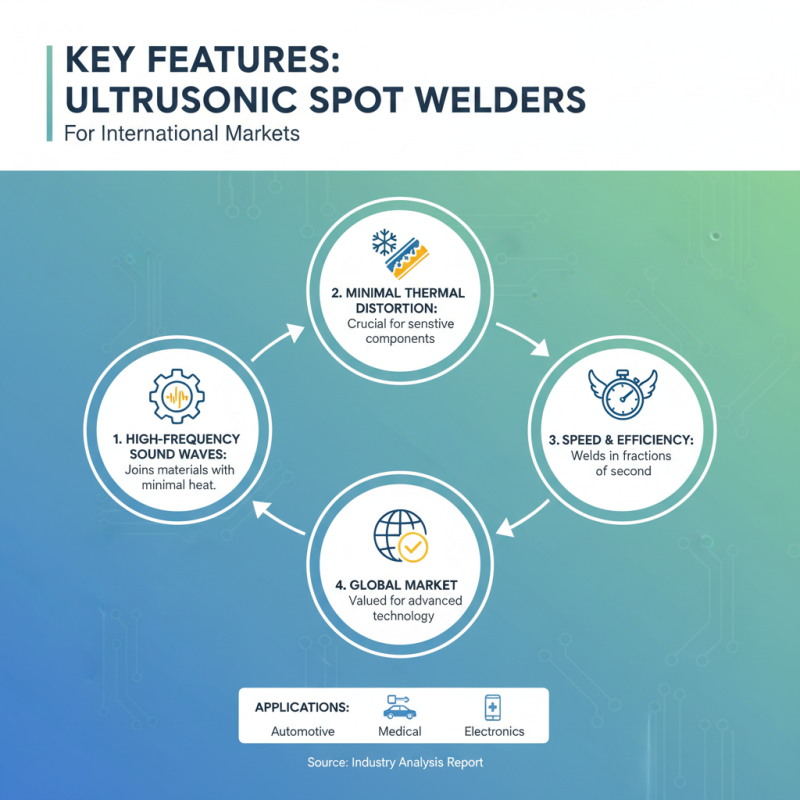
Ultrasonic spot welders are gaining traction in global markets due to their unique features. These machines use high-frequency sound waves to join materials without generating excessive heat. This method ensures minimal thermal distortion, which is crucial for sensitive components. Buyers value the speed and efficiency of these welders, as they can complete welds in fractions of a second.
Reliability is another key aspect. Ultrasonic spot welders operate consistently, producing strong, repeatable welds. This is vital for industries that require high precision, such as electronics and automotive manufacturing. International buyers appreciate the versatility of these machines. They can effectively join a variety of materials, including plastics and metals. However, users must ensure appropriate settings for optimal results.
Despite their advantages, users should remain aware of potential downsides. Not all materials are suited for ultrasonic welding. In some cases, significant adjustments are required. Additionally, maintenance is essential to keep the machines running smoothly. Ensuring proper care can prevent costly downtime. Overall, understanding the features and limitations of ultrasonic spot welders is crucial for effective use.
Advantages of Ultrasonic Welding Over Traditional Methods
Ultrasonic welding offers distinct advantages over traditional bonding methods. One key benefit is speed. According to a study by the International Ultrasonic Association, ultrasonic welding can complete joints in just milliseconds. This rapid process is crucial in industries like automotive and electronics, where time is money. Moreover, ultrasonic welding requires less energy, making it an environmentally friendly choice. This efficiency aligns with sustainability goals.
Another significant advantage is precision. Ultrasonic welders create strong bonds without damaging sensitive materials. For instance, delicate electronic components can be joined without the risk of thermal degradation, a common issue with traditional welding. A report from the Welding Institute highlights that ultrasonic welding achieves up to 90% joint efficiency in specific applications, emphasizing its reliability.
While ultrasonic welding is beneficial, it is not without drawbacks. Equipment costs can be higher than other methods. Additionally, not all materials are suitable for ultrasonic welding. Careful consideration and material testing are necessary. Just like any technique, understanding its limitations is vital for successful implementation.
Top Ultrasonic Spot Welder Benefits for Global Buyers
| Benefit |
Description |
Traditional Method Comparison |
| High Speed |
Ultrasonic welding completes joints in a fraction of the time required by traditional methods. |
Conventional welding methods are generally slower, often requiring additional time for heating and cooling. |
| Energy Efficient |
Uses less energy compared to traditional welding, which requires heat generation. |
Traditional methods can consume significant power during the process. |
| Minimal Material Distortion |
Produces less thermal impact on the materials being joined, preserving their characteristics. |
Can cause warping or distortion due to prolonged heat exposure. |
| No Need for Additional Fasteners |
Creates joints that do not require screws, bolts, or adhesives. |
Often requires various fasteners that can increase complexity and costs. |
| Strong and Durable Joints |
Creates robust joints suitable for a variety of applications without compromising integrity. |
Welds can be weaker or less reliable if not performed correctly. |
Cost Efficiency and Energy Savings of Ultrasonic Spot Welding
Ultrasonic spot welding has gained significant attention due to its cost efficiency and energy savings. This technology uses high-frequency sound waves to achieve quick and reliable welds. As it operates at a low temperature, it reduces both energy consumption and material distortion. Buyers seek solutions that minimize expenses while maintaining quality. Ultrasonic welding often fulfills these needs by speeding up production processes, ultimately leading to reduced labor costs.
The energy savings associated with ultrasonic spot welding can be substantial. Traditional welding methods often rely on high heat, which consumes large amounts of power. In contrast, ultrasonic processes can operate using less energy, leading to lower operating costs. This is particularly appealing to factories aiming for sustainability. However, it is essential to note that initial equipment costs can be a concern. Prospective buyers may need to weigh the benefits against upfront investments. Over time, savings on energy and materials can offset these costs, making ultrasonic technology a worthy investment.
Moreover, not all welding tasks benefit equally from ultrasonic methods. Some applications may still require traditional techniques due to material compatibility or specific requirements. Buyers need to reflect on their needs and evaluate whether this technology aligns with their production goals. Balancing performance, cost, and sustainability can present challenges, but many manufacturers find value in embracing these advanced welding techniques.
Applications of Ultrasonic Spot Welders in Various Industries
Ultrasonic spot welders have gained traction across various industries, owing to their efficiency and precision. In the automotive sector, these machines have transformed how components are joined. Reports indicate that around 25% of vehicle manufacturers have integrated ultrasonic welding in their production lines. This technique offers reduced cycle times while maintaining high bond strength. It’s especially effective for joining lightweight materials like plastics and aluminum, crucial for modern vehicle designs.
Electronics is another key sector. Many manufacturers rely on ultrasonic spot welding for assembling delicate components. The process minimizes thermal damage, which is vital when working with sensitive components. Research shows that ultrasonic welds can significantly reduce the risk of defects, leading to a 30% drop in manufacturing errors. However, challenges remain. Some users report difficulty in achieving consistent weld quality, highlighting the need for proper training and equipment calibration.
In the medical device industry, ultrasonic welding plays a pivotal role. It creates secure, hermetic seals for devices that must meet strict sterilization standards. Studies suggest that about 40% of medical device manufacturers utilize ultrasonic spot welders to ensure product integrity. Yet, the variability in material properties can affect weld performance. This inconsistency calls for ongoing evaluation and adaptation of processes to harness the full potential of ultrasonic technology.
Future Trends in Ultrasonic Spot Welding Technology for Buyers
The future of ultrasonic spot welding technology is rapidly evolving. According to recent industry reports, the global ultrasonic welding market is expected to grow at a CAGR of approximately 7.8% from 2023 to 2030. This growth signals a strong trend towards automation and smarter manufacturing.
As manufacturers seek precision, ultrasonic spot welding offers superior accuracy. It significantly reduces the heat affected zone, enhancing product integrity. This method is not only energy-efficient but also minimizes material waste. Buyers should note that the rise in sustainable practices is encouraging investments in advanced ultrasonic systems.
**Tip:** Prioritize systems offering data tracking for quality control.
Future trends include the integration of AI and IoT in welding machines. Such technologies will enhance predictive maintenance. Companies can leverage these advancements for increased efficiency and reduced downtime. However, careful consideration must be given to training staff on new equipment.
**Tip:** Invest in training programs for optimal technology use.
The emphasis on modular designs allows for flexibility. This means that machines can be adapted to varying production needs without substantial downtime. While innovative, buyers must be ready to deal with the learning curve associated with these advanced systems.
Top Ultrasonic Spot Welder Benefits for Global Buyers